Saturday, June 24, 2006

Arts: Movies: Presbyterian layman, entrepreneur couples tech-innovtn to public morals, impacts Hollywood

.
Originally published May5,2k6
.
.
In a h+ly-slanted news article which nevertheless is chock full of factoids new to me, Justin Clark of Nerve.com (pornwarn!), writing in AlterNet's MediaCulture series recounts in his way the story of Philip Anschutz, a Presbyterian layman who had an idea about the sad state of movies and how to manoeuvre investments to find a toehold where distributors at the retail end and closest to consumers (we're talkiing movie theatres here) were going belly-up across the USA. They no longer attracted customers eager for their wares.

Anschutz developed a business plan to make his investment in dying movie houses produce a return that would permit innovation to win back audiences. Part of his plan was sheer ad-consciousness: he innovated the 20-minute pre-movie commercial ad-package which has now become standard in theatres that want to stay alive. He also innovated with the use of h+tech fibre-optic cables to deliver digitally the movie to the Big Screen.

All this turned on ins+t into the product that Hollywood was and is still relentlessly delivering to addle the brain and morals of American society. Despite reporter-opinionist Clark's anti-Abschutz bias, we can distill some important factoids about Hollywood's failure to love its audience:

In 2005, PG-rated films outperformed R-rated films in the theater for the first time in two decades. Conservatives have touted weak theater attendance as proof that the heartland isn't interested in Hollywood's licentiousness and liberal politics. Dove Foundation, non-profit advocates of "wholesome family entertainment", published a study showing that G-rated movies are eleven times more profitable than R-rated flicks. ... Although Hollywood didn't heed Dove Foundation's advice in 2005 -- the key Oscar nominations were all low-grossing films that are very political -- studios have begun looking into releasing PG versions of their R-rated fare, an innovation made possible by the advent of digital cinema. The double release would allow theaters to play the cleaner version during more lucrative screening times earlier in the day, and the director's cut later on. ...[T]here is no shortage of screenwriters willing to lend Hollywood's product a cleaner sensibility. In December, Atlantic Monthly reported on Christian screenwriting school Act One, whose faculty includes producers and writers from mainstream shows like Buffy the Vampire Slayer and That '70s Show. In 2004, conservatives launched Liberty Film Festival; last October the festival included a panel discussion titled, "Was Communism a Threat to Hollywood?"
That last tag-on comment by Clark is revealing of his prejudices, and its worth dwelling on a moment. The key idea is expressed in Clark's earlier comment: "What's good for the theater lobby isn't necessarily good for those of us who don't want our entertainment censored." Censored? What about the much larger group of people who have been subjected to last-stage Hollywoodism that prevents going to the movies with the kids, or has discouraged so many of us that we've broken our habit of customing the movie theatres entirely? Clark is simply and simplistically tendentious in regard to who is ceonsoring whom. Clark resents that a Christian force has gained sufficeint cultural power at present (it may not last long) to offer movies to famlies who want to bring the kids along (and not necessarily to "kids movies," rather to non-offensive films that offer drama and/or entertainment values that many adults find worthwhile, whether the kids are with them or not).

Hollywoodism is still entrenched; but it's got some competition; Clark wants to paint this cultural competition as monopolistic, censorious, sectarian (that's why he keeps referring to denominations of people in the industry of whom he doesn't approve); but the new pluralism in the industry has actually none of the characteristics he ascribes to it. Clark can't fathom cultural pluralism. Too bad. I welcome the development as quite a healthy one for American culture. But it's still a small minority presence in the overall structure of the demoralizing-industrial complex that is the movies these days, an industry which is still stacked against Christian cultural competition. It doesn't mean either that films focussed on difficult subject matter won't emerge from the newly-rising competition; but a space will be opened for adventurous new approaches and kinds of stories.

Snarky Clark adds, "Perhaps the more pressing question: is Hollywood ready to compensate exhibitors by eschewing edgy politics for movies with a built-in audience?" So, it is "edgy politics" he wants more than anything else. Yet, already Holltywoodism has contributed to making everything political, ideological, propagandistic, and "correct" - especially in the hypersexualization of children, the amoralist treatment of relationships, the inablity to portray tragedy without swerving into nihilism.

Were Clark capable of a bit more cultural honesty, he would acknowledge candidly that there are many built-in audiences for various American movies. It's really hard to deny that Brokeback Mountain had a built-in audience; and altho, I'm happy it was made and distributed, it certainly was a letdown as an Oscar nomination for Best Picture. That kind of eventuality simply devalues the Oscars. But apprently an even worse movie won - it's winning feature being that it dumped on the public the by-far-largest count of curse words in movie history. As one movie wag told me, that was the flick's only redeeming feature. A childish overindulgence in Gross-Out, to which only a small fraction of the movie-going public is addicted, altho Who's Afraid of Virginia Wolfe may come close.

Thanks, Mr Anschutz for the possiblity of alternatives to Mr Clark's cinema fetishes. - Politicarp

Further resource:
Roger Ebert's Movie Glossary

Arts: Architecture: Frank Gehry transforms Los Angeles locale, Grand Avenue towers to surround his Disney Concert Hall

.
Originally published May5,2k6 on refWrite page 3.
.
The Internet now offers a one-man blog devoted interestingly to architure, and sporting the polyglot name el Zeit de la arquitectura, achknowledging that the art and engineering both is internantional and language-transcending. César A's latest post as of Thursday, May 4 at 9:00 PM, features an item on Frank Gehry's vast new development of the Grand Avenue area of Los Angeles as a setting for Gehry's already built and in-use Walt Disney Concernt Hall. When you get to Zeit (as in Zeitgeist = Spirit of the Age), click from this item to Los Angeles Times (you may have to register) for the originating article by Cara Mia diMassa (Apr24,2k6)

Architect Frank O. Gehry plans to erect a translucent, glass-curtained tower rising 47 stories above his landmark Walt Disney Concert Hall as the centerpiece of the Grand Avenue project, a bold statement that would alter downtown Los Angeles' skyline and reinforce the civic center area as a hub of cutting-edge architecture.

His schematic designs, which have been eagerly anticipated in world architecture circles for months and are to be unveiled at a news conference today, call for two L-shaped towers, the 47-story structure and a 24-story building, at opposite ends of the block east of the concert hall.

The designs are for Phase 1 of an ambitious plan by developer Related Cos., philanthropist Eli Broad and top city and county officials to transform a part of downtown known as a 9-to-5 office community that turns off the lights at sunset into a vibrant place where people would live, shop and dine.

"I think that there is a desire on the part of the city and county to do something special there," Gehry said. "We are trying to make that happen, so that that connectivity would result in a sense of place that's bigger, that the whole would be greater than the sum of the parts."
There are an enlargeable pix for a bit of a better look than either Zeit or this LAT> article page can provide. There's also two Adobe Acrobat downloadable files to get a better and more detailed overview of the project.

Back to Zeit: There's also a photo of one angle on the new Jalisco Library, Guadalajara, Mexico, built by LOT*EK, another site to which you can click. The architect is A. Arcuri. A wonderful further explanation and visual of this fantastic building is explained in these terms:
Over 200 Boeing 727 and 737 fuselages are stacked in a north-south slant in relation to sun exposure for energy efficiency. Two shifts in the direction of the main axis of the fuselages generate two large open spaces within the stack.

The building utilizes the space inside the fuselages to contain and organize functions that require enclosed spaces - such as book collections, meeting rooms and administration offices, - while the 2 large open spaces house a large atrium with all the reading areas on one side and two auditoriums on the other.

The library program is centered around the large glazed atrium, which develops vertically through the entire cross section of the building. The lower part of the atrium, located on the second level and accessible directly from the new plaza thru escalators and elevators, functions as a lobby and information center. At each upper level, the reading areas bridge between the two opposite interior facades generated by the cross sections of the fuselages that look onto the atrium.
You don't want to miss the amazing large pix of the Jalisco Library in Guadalajara at this last link. Go there!

And César has more amazing architectural visuals with brief comments for you. - Anaximaximum

gheryfrank, losangelesarchitecture, guadalaharajaliscolibrary, pix

Satire: Writing it well: Melanie Spiller exults in Jonathan Swift, seconds with Sam Johnson, asking who's still doing it well?

.
Originally published May3,2k6 on refWrite page 3.
.
Has all the thawt-space (denkraum) for good political satire in the English language been occupied by the Greats already long ago? That's the question that emerges from wordsmith Melanie Spiller's musing on Jonathan Swift and his Gulliver's Travels which hit the h+water mark for the genre at its outset in our tongue, it seems. She orients us to her question, to Swift, and to Gulliver's first adventure in her article Writing Political Satire on Office Zealot, where you mite not expect the theme:

Does anybody write satire anymore? Oh, I don’t mean satire of the Saturday Night Live ilk. I mean the really writing a good tale that is part parable, part morality play, and a hundred percent tongue in cheek. Did satire come to an untimely end with the likes of Samuel Johnson and Jonathan Swift?

Let’s look at Gulliver’s Travels, shall we? Let’s see what a miracle of satire it really was, and then maybe one or two of you, gentle readers, can tell me about any comparable satire written by our own contemporaries. I’d sure like to know about it if it’s still being written.

Okay, here’s the story of Gulliver in a nutshell, in case you haven’t read this since you were 12 (it deserves an adult reading, for sure): Lemuel Gulliver, a failing businessman and surgeon, is shipwrecked. He awakens to find himself tied to the ground by tiny threads. His captors are the itty bitty Lilliputians and are prone to violence, scurrying all over him to secure him. They feed him at great expense (he consumes more than a thousand Lilliputians could) and he is presented to the emperor as a form of entertainment. Despite his captivity, the Lilliputians use him as a weapon against the enemy during a war about a silly principle (the proper cracking of an egg). Gulliver is convicted of treason when he urinates to put out a fire in the royal palace. The emperor pardons him at the last minute and he trots off to the land of the enemies, where he builds a boat and sets sail for home.

Of course, that's just the first of Gulliver's four adventures, as mentioned. But let the part stand for the whole - that special form of metaphor called "metonymy" (there are others too, as when the whole is used to substitute for the part, etc). We get the concreteness of Swiftian imagination, in one thumbnail.

But more largely, there's a great societal issue being explored, litely reduced to amusing terms, without crude thrashing and bashing as some satirists resort to, quite as a reflex action, these days.

Thru-out her piece, Melanie keeps inquiring whether her readers are aware of anyone writing political satire with a deft touch of excellence in the genre today. I've been wondering about this as well. I know that in cartooning, the witty USA-born Israeli, Yaakov Kirschner (who is sometimes carried on refWrite's frontpage) has that deft and yet telling touch; he deals with the most searing topics in a way that muses us as he amuses us. A fine art in itself! But I wonder, like Ms. Spiller, is anyone writing satire that can appeal to a wide audience, a morally-sensitive audience that doesn't want to hide from difficult issues but doesn't want to be drenched in much and curses while journeying into a writer's subject matter. I'm wondering if there's a niche of satire-writing that a wide Christian readership can look for, and be provoked by, and not simply slammed by compulsive insulters? Maybe I should raise some money, and offer an annual prize in satire written with a Christian readership in mind who are up to the provocations of a latterday Swift. - Anaximaximum

satire, swiftjonathan, johnsonsamuel, satirecontemporary, satireprizeannual

Friday, June 23, 2006

Technics: Blogging abuse: Pluthero's impersonation & IDtheft shown again in his ongoing attack against refWrite

.
Hat Tip to Technorati for this further evidence of Dr Fraud (real name: Fred Pluthero) impersonating and stealing ID on his attack-blog using my name, Albert Gedraitis, which is aimed at smearing me.

Fred Pluthero text under my name AG - 300+days ago.

This one from Pluthero goes back some 300+ days, but it's a project of a blog abuser who appropriates the name of others, their blog titles, their creative products without attribution, and puts these stolen elements in his Blogger blogsite title as a permanent attack for the purpose of character assassination. The 300+ days-old item, reproduced again here as further evidence, has been made current by a quite recent blog-entry by Dr Fraud Pluthero.

In the more recent sortie into fraud on the same theme, Fraud Pluthero lifts a response from a third-party to my response to the third-party's original article. The original article and the concluding article in this completed discussion are by a seminary professor at an evangelical institution who teaches philosophy and follows ordinary-language philosophy to what-for-me is its dead-end result, but does so to his own satisfaction and that of his institution. I gave him the last word, as I had said what I had wanted to communicate. He and other readers have a long time to reflect on whether his last word is the best approach in the exchange. I feel no obligation to either further enter into argument with that author, nor to reproduce his work. Rather, I have brawt over from its first online location the text of my article, presented as a Special Feature on my own blog refWrite (Fraud Pluthero has also appropriated my blog title just mentioned which preceded his of that name by years). As to my republication of my Feb2k3 article, I have never intended to just have it sit there as a duplicate. I hope to do some re-writing, at my own pace, dropping the references to the occasion that stimulated me to enter the exchange with the seminary prof in the first place, add the booknotes to form a bibliography of the volumes that influenced many of my ideas (I did a lot of research preparing, not for the article as such, but for the long poem that sits unfinished but is titled as "Holy Monsters from the Dark Scriptures of Lent." I would also like at some point to write more about "historical imagination" in source-respectful historical thinking, including respectful historical thinking about the New Testament.

Overall, Dr Fraud evidences another motive than that of fairness, and attributes his pirate republication of the third-party's essay, on the fraud-frawt abuse-blog which uses my name in its/his title, puts all sorts of fakeries in the first-person to make-believe its my voice. But he is thoroly misrepresenting my voice, and appropriating both my work and the third party's work for his own abusive purposes.

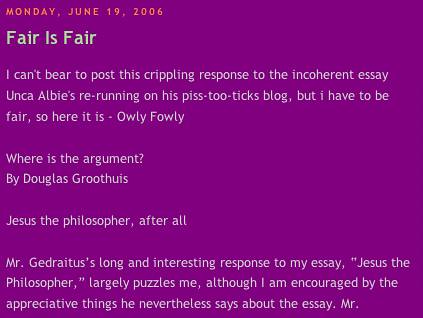
Here's where he steals my dialogue partner's text, without attribution or a live-link. But rather he sets off his gambit with an intro that attempts to falsely characterize me, again.

Fraud Pluthero Fair is fair beginning

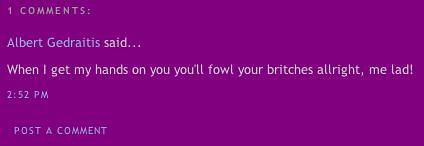
Now here's a rude comment he attributes falsely to me, a bit of meanness that Fraud Pluthero composed himself.

Fraud Pluthero Fair is fair ...fake comment

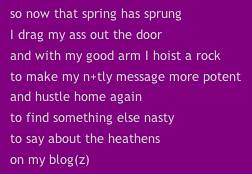
Going beyond even this kind of gambit, Fraud Pluthero has actually promulgated outr+t lies. Here's one from the perpetrator's deceit-peddling of Apr28,2k6. His blog-entry title is an utter falsehood that he made up entirely.


Fred Pluthero's lie about Chan windshield


Then, below this lieing title, comes some verse with which Pluthero the Perversifier concludes in the following extension of the falsehood of his title (which Fred Pluthero wrote, not Albert Gedraitis ... and likewise Pluthero, not Gedraitis, wrote the mentioned verse below):

Fred Pluthero verse-lie about Chan windshield


In comparison, here's the actual text of my poem, "paralysis".
You'll notice the fraudulentlies insinuated into my text by impersonator-IDthief.

I repeat that the title and final verse of this poem on the coward's blog is written by Dr Fraud himself, Fred Pluthero; it is not written by Albert Gedraitis, altho Pluthero tries to stick it in my mouth. As he steals, alters, and corrupts my work he renders it a false accusation against me, understanding which helps me and all readers gain ins+t into the techniques of Pluthero's obsessive character assassination, awareness of from where his smear tactics originate: cowardice and deceit. -- Albert Gedraitis

Art: Journalism Photography: Picture of the Year Awards, Missouri School of Journalism

.
This blog-entry has been transferred here from page 3 to the new refWrite Backpage (page 4). The move completes the transferral of all the April blog entries to this page, their new home. It was first posted Apr27,2k6. There were 12 page-3 blog-entries made in May, all of which remain to be moved to the Backpage; and there were 5 earlier in June, also to be moved in due course. Slowly but surely. There will be some editing of the moved blog-entries, at the end of the moving process
.
Every year the Missouri School of Journalism goes thru an elaborate process of juried selection of what the judges consider to be the best photos from journalist-photographyers in numerous categories. The result is a rich feast of photographic art in which "every picture tells a story...." This year the 63rd Picture of the Year International awards (2005, judged in February and March 2006) is no different; and the results are posted on the Internet for you to see.

First off, you may want to visit the webpage that describes the Award process, and serves as a launch point for you to view your own selections by topic. From there you may want to go to the Complete Winners Gallery with live-links to each of the various categories. Or, instead you may want to view the overall First Place Winner's work, Barbara Davison of Dallas Morning News, who thereby is named Photographer of the Year as a professional Award. Nine of her photos this year can be accessed from the previous link. Take a look!

Because so many of the photos are somber, I've paused to pick out from the "World Understanding" category this splendid work of beauty to whet your appetite.

From Clipboard.

This is one of 34 photos by Lemoyne Roger (Redux / Alexia Foundation, winner of the World Understanding Award; the work is entitled, "Democratic Republic of Congo." Here's the text that tells the story another way:

March 26, 2005. Fishermen ply their age-old trade on Lake Albert, despite the turmoil that has engulfed the Great Lakes Region in recent years. Summary: This series covers the conflict in Eastern Congo and the UN led effort to bring peace. The deadliest since WWII, it persists in part because of the plundering of the Congo's immense mineral wealth by militias and neighboring countries. Ethnic strife that has torn the Great Lakes region apart is also a factor. A recent referendum on the constitution and elections planned for 2006 offer hope for this Western-Europe sized country that hosts the UN's most expensive and amibitious undertaking in the world. In the war-ravaged eastern provinces of the D.R. Congo in the Great Lakes Region of Africa, MONUC (the United Nations Peace Keeping Mission to the Congo) has given militias until April 1st to turn in their weapons and join the de-mobilization and re-integration program run by the UNDP (United Nations Development Program). Although the program had been in effect for months, there had been limited disarmament. Once the deadline had been set, a flood of militiamen, including child soldiers, suddenly entered the program.
Art Talk, by Anaximaximum

The winning photograph in the World Understanding category is a serene, even idyllic, narrative of men going about their daily work on the lake; it uses the silouette in the foreground to give the us a point of view. Somehow tho, it's the gnarled tree limb that is the visual center of the photo's image field, and I read the aged gnarling as metaphor for the society's virulent ills and suffering, in contrast to the calm of the lake, the sky, the fishermen, the nets, the daily work with its routines and order.

aesthetics, arts, photography, journalism, moschljournlsm, pixyearawards2005
Tags: Pluthero's impersonation, identity theft, character assassination

Technics: Web: Search engines fail, too bloated to give yesterday's news no matter how clear the search parameters you supply

.
I got an assignment from Uncle Owlb. He wanted me to find an article on the web from yesterday, Apr25,2k6. He showed me what was annoying him, as he had the whole article's text sitting there onscreen, r+t before his eyes. It was an article by Anne D'Innocenzio, a business reporter for Associated Press. Unc wanted to attribute the article to the author and live-link to it. But, where he had found the item, it proved impossible to live-link to it, because it was locked-in on a page of another website without the article's AP URL.

The offending lock-in was found on Business Reform magazine online, aka ChristianBusiness.net.

refWrite's TechNotes, by Owlie Scowlie

As far as Unc was concerned, and I agree with him on this, this locking-in of someone else's article, so that a blogger or other user can't give the proper URL to one's readers, just as article's URL was originally put out on the web: this practice is a Bad Business Practice, a sub-Christian practice to further a self-styled Christian org's own agenda and violate an online consumer's r+t to give an honest attribution of the source and author at a proper URL. In short, a self-serving form of business dishonesty to lock a reader onto the page in question, instead of providing the link by which to navigate out to the original source. I had thawt this kind of BBP was illegal, and if it ain't, I say it awt to be. I don't see any God-fearing humility here in locking-in an author's work.

Here's the URL at the top of Business Reform / Christian Business's page: [ http://www.businessreform.com/ext_link_w_frames.php?url=
http%3A%2F%2Fapnews.myway.com%2Farticle%2F20060425%2FD8H72OQO0.html ].
Even that gargantuan URL is part of the obfuscation, but you can see tyhe traces of the original URL locked-in by the BR/CB take-over frame.

First, the top of Christian Business page is a blank, no page title appears on your browser's topmost line, only a hyphen; it appears the same way when you save a BR/CB URL for an article that isn't even theirs to lock-up. They invade your URL files with their perfidy. You can write in a title of the article you want to save, but anonymity, secrecy, deception, and removing the name of the author and the orignal publisher is the name of the Christian Business's game in using others' news reports.

Then, Business Reform (CB's other name, remember) gives you its own super-imposed frame in which it promotes its own pious articles and commodities that it sells to unperceptive readers who have little knowledge or care that the page is an article rip-off of another publisher (in this case Associated Press via MyWay) and a real professional newswriter - namely, in this case, Anne D'Innocenzio.

Well, I then set out on a search for the author's original article elsewhere -- that is, on the website ripped-off by Christian bad business practioners who will not supply the proper URL for proper attribution. My search beyond was a nite-mare. I went to MyWay, I googled and got all sorts of garbage but not the article for which I had the publisher's name, the author's name, the full and correct article title, and the publication date - yesterday! Then I tried Yahoo! News's search engine, then Ask.com, which sent me to FindArticle.com, then LookSmart. One wanted to have me install Mamma.com software in my computer so I could search my own hardrive, all tried to sell something with all those nonsense ads that merely obstructed the page, none could give me the page with its URL. There's someting massively wrong here with search engines on the Internet, and I guess I should be grateful to ChristianBusiness.net for their selecting D'Innocenzio's article on consumer confidence in the economy r+t now - even tho they didn't have the Christian decency to supply the URL so I could navigate out, so Unc could give credit where credit is due.

But that's not the end of it. Besides MyWay which had already disappeared the article from the list of stories they're featuring today, I googled up Associated Press's frontpage, and among all the bloat of their geegaws and doodads, the very small list of current articles they offered did not include yesterday's news, certainly not Anne D'Innocenzio's "Consumer confidence highest in 4 years." But, hey, I just remembered there used to be an AP article-list site out of Tampa, Florida, maybe a webpage maintained by a newspaper there. Better go take a look ..... - Owlie Scowlie

Your website spellings & Search Engine deficiencies

Search Engine deficiencies and access to health info


technics, searchengines, internet, frames, businessreform, christianbusiness, businessbadpractice, myway, associated, press, google, yahoonewsearch, looksmart, ask.com, findarticle.com, mamma.com

Technics: Info Systems & Philosophy : Books about philosophical basics of technology, philosophy of technique, technics

.
Scholars oriented to reformational Christian philosophy have produced several very valuable studies on the philosophical basics of technology as special science of technics. The word "technology" is overwhelmingly used incorrectly, as tho the suffix "-ology" was just a throwaway. Not so, strictly speaking. Technology is the science which analyzes and theorizes the realized specific techniques that have come and are coming into existence today and tomorrow, and their patterns and inter-relations and impacts on the rest of existence (in plants, animals, humans, and even aliens if they ever arrive from outer space). Technics is a modal dimension universal to created existence, and a modal science that is at once h+ly abstract precisely in order to embrace all phenomena in their technical aspect, whether dominant, central, focal and qualifying / foundational in a phenomenon (sphere specificity); or nondominant, auxiliary, peripheral and subsidiary in a phenomenon (extended sphere universality).

The technological study of information systems is one of the key intellectual disciploines of modern life, and neither technology in the study of techniques, nor technics as a universal modal science (Dooyeweerd, Seerveld, Schuurman) can afford to neglect info-system analysis and search for ins+t (note that my very spelling using a plus sign [+] to indicate a long-sounded "i" and to differentiate that long sound by a "+" in contrast to the short sound indicated now by the usual "i") is a specific micro-technique of spelling). Info systems are much more specialized now with the devlopment the technical complex based on electromagnetic transmission of binary and other pulses thru machines (computers, devices, etc) equipped with program interpreters (codes, encryptions, etc.). This complex is often called "computer technology" but in reality it is computer technique or computer technics, information technique or info technics. A computer itself is a machine (hardware).

Jacques Ellul established this usage in French in his book, entitled La technique, But, unfortunately, when translated into English it appeared under the misnomer The Technological Society – whereas it is his book itself (like every book a constellation of techniques, such as printing) was an analytic discursive work of technology, technological thawt – that is, a scientific-philosophical reflection on techniques, as they disclose a universal modal aspect of creation, its law-order and its appearances in everyday life. So, I argue against the common English usage here because it's too conceptually narrow, limiting and distorting; but usage is usage, changing usually at a very slow pace. - Owlb

New Book:

Sytse Strijbos, professor of informatics at the Free University (VU) in Amsterdam (a former student of Hendrik van Riessen [The Society of the Future] and Egbert Schuurman [see below]) and Andrew Basden, professor of information systems and their human factors, at Salford University, Salford, England, UK. have together produced a symposium of diverse stances making use of the philosophy of Dooyeweerd, Van Riessen and Schuurman.

S. Strijbos and A. Basden (2006)
In Search of an Integrative Vision for Technology:
Interdisciplinary Studies in Information Systems

Publisher: Springer.
Catalogue Data: ISBN-10: 0-387-32150-0 ISBN-13: 978-0387-321509

Expensive! - from Andrew Basden on Thinknet

Biblography of Reformational-Philosophical Works on Technics
Compiled by Gregory Baus©April 22, 2006

Egbert Schuurman (b. 1937), studied Civil Engineering at the Technological University of Delft and Philosophy at the Free University of Amsterdam; is Professor in Reformational Philo­sop­hy at the Technological Universities of Delft and Eindho­ven and at the Agricultural University of Wageningen. He is also a member of Dutch Parliament. Some available publi­cations in En­glish are:
Technology and the Future -- A Phi­losophical Challenge (Wedge, Toronto, 1980) Translated by Drs. H. Donald Morton

Reflections on the Technological Society (Wedge, 1983.)

Perspectives on Technology and Culture (Dordt College Press, 1995)

Faith, Hope and Technology (Clements Publishing, 2002)

Technological World Picture and Ethics of Responsibility (Dordt College Press, 2005)

----------

Here is a bit about Schuurman's work.

Here is an online essay by Schuurman on ethics of technology.

Here is another Schuurman essay on ethics of genetic engineering.

----------

Here is a paper on (a Dooyeweerdian view of) the aesthetics (art) of engineering design by Charles C. Adams

technics, technology, techniques, philosophy, info, informatics, infosys, infosysdigital, cybernetics, strijbossyste, basdenandrew, elluljacques, book, print, +, computer

Satire: Religion: Comedy Central unconvincingly disavows 'South Park's religious parody

.
The cable TV network, Comedy Central, is a miracle of the 500-channels technics wrawt by the mass-communications industry, a miracle that enhances cultural pluralism if allowed and protected by the a society's political order, especially in conjunction with unrestrained reception of satellite signals from near-space (satcom). In North America, we've got it except where we're limited by the intermediation of the cable companies which funnel the full panoply of possibly programs thru a wire coming to your house (or place of business, etc). That's the same funnel-wire for many over which they receive their personal computer transmissions from an Internet Service Provider, and indeed via the Net and the WorldWide Web part of it, you an receive even more than the relative figure of 500 channels.

Comedy Central is one of the "500." And it has a huge following. Included in that huge following for CC is none other than the seasonal show South Park.

The writers/creators of SP are Trey Parker and Matt Stone, by no means old-codgers they inherit the American tradition of masscom satire/parody/assault founded by Lenny Bruce.

Unlike Bruce, they evidence no social disablity, except perhaps the Too-Much alienation of the wasp-background middle-class (a benchmark typification I employ metaphorically here because I actually have little knowledge of either of their sociological profiles). But it seems fair to say they are not proceeding in their work from the emotional near-disability of a Bruce, but instead are humorists first and foremost. They work with animated-cartooning accompanied by recorded voice-overs supplied by professional actors/readers in most cases.

So, to say the duo "write" the show is a metonomy that displaces from the multi-disciplinary zone of their creativity of several masscom specialist disciplines to just one. Thus, better than the designation "writers" they fully are entitled to the usage "creators" in order to cover the list of artistic disciplines they command , all at once. One must accord to them the terms "artists" and even "geniuses" at what they do for a financially well-rewarded living.

But the assult-moment in the Bruce tradition is very much with them in their wasp-like privileged sociographic pedigrees. They aim what has often been called on the post-comments on the Web an adolescent genius for mockery that one after another sticks the pin to every inflated balloon they can manage to find with some hope of widespread recognition within their audience. This means there are no potential targets immune to their long-delayed "adolescent humour" which is essentiallly gleeful mockerty appllied snap! snap! snap! by contrasting sound-bytes (usually) from voices reminiscent of each of the seven dwarves.

This gambit as a professional strategy for the comic arts has religious implications because it prevents them from making any fine distinctions among the potential targets that are fair game. They indulge in so widely distributed a general spoofing that they produce dialogues that are at once antiJew, antiBlack, antiHispanic, anti Christian (of several varieties), antiScientology, antiGay, and antiSeeminglyEverything except antiAnti. There are no sacred cows for Parker and Stone. And all of this they convey thru squeaky little gnomic characters seemingly in their prepubescence but often wiser and meaner than their apparent ages would suggest; they are also some adult characters to serve as foils to the revived Little Rascals of early American film.

This ethos which makes an sbsolute value within the contours of the SP show, episode by episode, broadcast season by season, of no values-but-mockery, no-gods-but-parody. Outside the show, however, we can't make any judgment at all about the personal ultimate-values of the writers of SP. For all intents and purposes we just don't know.

Within the contours of the product as broadcast and viewed, however, we are well and r+tly positioned to analyze and make judgments, an activity other than laffing, wincing, or clicking off the tube. This is parody art that knows no master and no transcendent value beyond than the pursuit of humour at whoever's expense. For this reason, it was no big thing for Parker and Stone to depict Jesus as shitting on Bush and flag, and I gather being likewise shat upon himself (otherwise the Jesus-character would be given some special status, I would presume). In the past, SP has also nigrated Scientology (which mite offend Scientologists like Tom Cruise and John Travolta) but for vast majority of Americans is not regarded as a claimant to the status of "the sacred" and so not easily understood as a large enuff societal presence to be worthy of attack. In any case both Jesus and Mary, the Mother of God, in Christian traditions are targets worthy of middle-aged adolscent scorn. It's difficult to be fair to all major religions and protected minority-identities that contribute to the vital mix of our society.

This point is that at which the issue, from an immanence-critique of this masscom-professional art of mockery as a religion itself, comes into play. It would seem that in the recent episode that delited vast hordes of SP's fans and so outraged large numbers of art-critical thinkers and members of the targetted religion, those for whom Jesus is sacred and symbolic of the Good, have taken offence. Especially tell-tale is the fact that all sides acknowledge that a Mohammed character was implicated, but not degraded. This raised the specter that Parker and Stone were inconsistent, and simply anti-Christian within the contours of the show (let's be careful not to overextend our interest and concern to the ultimate values of the creative duo outside their profession, being careful on that matter to remain disinterested and agnostic).

But, the art of the creators of South Park is what's called pre-rationally polysemic and polyvalent. It has many secondary and tertiary values at play at once, and many semiotically-overcharged signs and symbols that are pre-analytic to the extent that they evoke numerous intepretations which can all be true at the same time. [In aesthetics theory I am a Seerveldian, and emotions-rooted semotics-founded analyst.].

The episode in question as broadcast included a prolonged frame with a text message that an appearance of a depiction of Mohammed had been censored from the episode by Comedy Central, and for the longest time many assumed this was so, but in the posts and comments on the Internet longtime viewing fans who had seen every epidsode ever aired in the history of the show maintained that this was just another parodic device, and I (in agreement) would add that it was semantically and semiotically fucntional in a multi-level way. Later, after the howl of bloggers and others on the Internet had dinned on for some days, Comedy Central issued a terse statement that it had intervened to stop the short segment of the (purported) Parker-and-Stone-intended display of Mohammed (but apparently without direct mockery parallel to the that of Jesus pooing and being poo-ed upon. My metareviewing take on the discussion is that Comedy Central was in cahoots with Parker and Stone from the outset. CC was not about to take a public position against one of America's most productive and widely-followed creative duos, albeit in the fine art of adolescent-seeming mockery. And it makes good commercial sense for all the masscom parties concerned, for Parker and Stone to use the device of censorship to add just another twist to the whole process, juxtaposing that in the same episdoe to the loathesome mockery of Jesus, while doctrinally true enuff as to the fleshiness of his humanity, had him "turning the other cheek" upon humans including the American president and the national flag. But this could be construed, too, according to one's politics, as positioning Jesus where he belongs - above the politics of the President and the American state.

As to the "failure" to depict Mohammed, we needn't spend time on batting about whether this was out of respect (in contrast to the disrepect of the Jesus character) or out of cowardice (fear of some Muslims going into fatwa mode against the creators and the broadcasters of the depcition that never happened).

My own position is that the American art of satire and its practioners should not depict Mohammed and should not not disrespect the images and symbolizing characters of Jesus or Moses or other foundational religious symbols held to be sacred by religious communities indigenous to American life and culture, as also now the Islamic Prophet is. One needn't pay hommage but one shouldn't offend the believers for whom such personaages are integral to their deepest feelings and ultimate values. There will be problems in understanding just who and how some more marginal religions should receive the general respect that makes for civil peace and feelings of inclusion in the social order. At the same time, I say this, I think we can (and I surely can) live with the fact that South Park is ensconced in the entertainment system and has its devotees. I don't have to watch it; and I don't very often because of the wide-scope of my TV watching, while I mainly blog. I've just clicked on the TV to catch the last 5 minutes of today's The Young and the Restless. Then comes the news with Kevin Newman on Canada's Global network. There are religious forces at play here in both of these as well, much more under the surface, much harder to discern the spirits. Next to them, South Park is a piece of age-ing adolescent cake. -Anaximaximum

Tags: Pluthero's impersonation, identity theft, character assassination

Technics: Blogging: Fred Pluthero devotes entire Blogger blogsite to impersonation and ID theft

.
Risk Manager
Quality and Risk Department
Hospital for Sick Children
Toronto, Ontario

re: Fred Pluthero's use of Hospital computers for his campaign of impersonation and ID theft

Hello -

I've been slow to get my answer off to you this morning (it's already 11:00 am).

These two Flickr images that I have created of the text of one of Fred Pluthero's false attributions to me are evidential. The first shows up in a Blogger Search of my name, that unauthorizedly uses my name in the URL. The second shows up on my tracking service and gives the location where he sometimes launches his invasions (from his place of work, the Hospital for Sick Children, Toronto with the ISP number of the computer he has most often used there) and the referrer blogsite already shown in the first bit of evidence, giving the URL (stealing my identity) of the
referrer blogsite by which he approaches my own sites, trying to mask his Hospital location and identity.

Evidence of Pluthero's attacks gathered from my Weblogs monitor service:

Fred Pluthero text under my name AG

-----------------

Evidence of Pluthero's attacks gathered from my tracking service:

pix of Fred Pluthero visit from SKids to his AG blog

Here is the email address he created on Yahoo to write at least one false letter attributed to me, and signed "Yours in Christ, Albert Gedraitis" which he sent to the Catholic School Board, faking that I was accusing 3 or 4 other persons of misbehaviour at one of the Board's schools. The Board has so far not been cooperative in giving me the full text of the letter, nor in helping get thru the maze at Yahoo.

Fred Pluthero's identity theft by email address: albertgedraitis@yahoo.com
I never use my own name in an email address, and I do use different monikers with different addresses so that my incoming mail goes to different boxes, as part of my filing system. Pluthero has maliciously put this system under attack, to suit his own purposes.

TechNotes, by Owlie Scowlie, scowling at Dr Fraud

Here are a list of my blogs, which I request be blocked from use at the Hospital:

refWrite (now 4 pages)

[ http://refwritepage1.blogspot.com ]
[ http://refwritepage2.blogspot.com ]
[ http://refwritepage3.blogspot.com ]
[ http://refwritepage4.blogspot.com ]

Anaximaximum

[ http://anaximaximum.blogspot.com ]

Christian Homomemo

[ http://homepage.mac.com/owlhoot/blog/ChristianHomomemo.html ]

Orthography

[ http://homepage.mac.com/owlhoot/blog/Orthography2.html ]

Reformational Cliosophy

[ http://www.freewebs.com/refclio/index.htm ]

Owlbirdsblog

[ http://owlbirdsblog.blogspot.com/ ]

==============================

Known attack sites operated by Fred Pluthero and from which he visits my sites, spams my Comments sections (he signs "effie," "great satan," "satyagraha" which now I divert to Haloscan), and in these "visits" he derives material from my websites to distort and make false attributions in my name to various other persons, places, religions, ethnicities.

Albert Gedraitis (my name, not his toy!)

Here's Fred Gordon Pluthero's full title of the blog he created to impersonate, vilify, and distort my thawts, and steal my identity and my artistic literary devices without giving any credit to me, but to use against me and against others for his own nefarious ends:

"Albert Gedraitis refWrite Redux Orthogrowlicus Anaximaximum Homomemo
I've Got More Blogs than An Irish Whorehouse"

[ http://albertgedraitis.blogspot.com ]

refwrite - holding onto truth - watch for foul-mouthed words and pictures, in some of the "previous posts" blog-entries. You will note on this site his reference to John Lennon and you will note that he says Lennon will take us from a world of "cowardice." But the truth is that Fred Gordon Pluthero never puts a picture of
himself on the web and uses several monikers, never his own real name and never his picture–all the while stealing the identity and artistic blog-literary devices I have created–while publishing a webportrait and using my own name Albert Gedraitis
designated as "publisher." My blog-literary pratice is honest; Pluthero's is dishonest and cowardly, sad to say.

[ http://refwrite.blogspot.com/ ]


The following names are used by Pluthero to branch out to others of his own blogs, where I have yet to see him reveal his own real-life identity. The immediate following was created under the name "harri o'balz" and used to vilify my Chrisian and homo identity. When he realized that this was too obvious a sexual innuendo to mock me for my always-outfront sexuality and vowed celibacy. Pluthero has an obsession in referring to me as "a wonker," "wonking," etc, and other terms for masturbsation. He knows nothing about my sexuality; and what he presumes is false, but he doesn't care about telling the truth apparently. Now he's got or renamed that cite to a clever variation, which my love of word-play encourages me to note its cleverness. Still, the unethical purposes to which he puts his attack sites has not changed much.

* haribalzac - (watch for foul-mouthed words and pictures (for instance, one image of my Lord Jesus Christ, so labelled, with the order "Masturbate!"

[ http://harisplace.blogspot.com/ ]


* Dharmatics (Pluthero also uses this spelling: Dharmatix) This is the site in which he pretends to be a Buddhist.

[ http://dharmatics.blogspot.com/ ]
[ http://dharmatics.netfirms.com/About%20the%20Author/cv.htm ]

* Owlberto - not put in use yet, but the name is a derivative of my totemic imagery
around "owl" - from "owlbird" > Albert.

* Satyagraha - Pluthero has often used this name to spam with lengthy ancient texts
the Comments areas on my blogs, sometimes making the whole blog inoperable: Satyagraha

email (old): abracax@sympatico.ca

I will write about this name later.

Here is the ISP numerical address that Pluthero uses when coming to my blogsite/s
from the Hospital:

142.20.156.186


Above is the analysis I have so far of the intrusions, impersonations, identity thefts, false attributions and distortions, sometimes bald-faced lies accusing me of
crimes (as he did in using my name to accuse other parties in relation to Holy
Name School, under the Catholic School Board).

--------

Note: This letter which I sent to SickKids Hospital yesterday has been edited for spelling mistakes, with some further details. - Albert Gedraitis, publisher

Tags: Pluthero's impersonation, identity theft, character assassination

Tuesday, June 20, 2006

Blogging: Process: We're almost moved from 'refWrite...page 3' to 'refWrite backpage' - blog moving

.
Third Update: refWrite is busy developing this new page, a page 4, as refWrite backpage. For now all the themes and columns appearing on occasion in the past on refWrite page 3, will at least temporarly appear on our new backpage.

Earlier in an update to this blog-entry which we've been moving up the daily archive list to keep it current, we noted that in this process from page 3 > page 4, we've discovered five unposted blog-entries in our archive. That five had been composed earlier and filed as drafts; so, their links may not all be uptodate. In any case, the material quoted (sometimes at length) and the writing of our columnists will be fresh on the refWrite blog as a whole and on its new Backpage.

Today, we proceed completed the transfer of the May blong-entries. Three or four June entires on page 3 still have to be moved. But today puts the first phase, the moving phase, into its endgame, is that the lingo?

The second phase will take longer, as we rake thru the entries moved for various editorial purposes, fix-ups, and analysis of the patterns we want to preserve, and those we want to change or jettison. An editorial review of our work covering all the blog entries that have now come to constitute refWrite Backpage.

Newer material has already appeared on the page. We will continue with new posts. Until the move from Page 3 to Page 4, we will be interspersing the older blog entries from page 3, as they arrive, with uptodate brand-new fresh blogs for your delectation.

As mentioned earlier, we will also be looking at what has turned out to be a list of columns and columnists, so we're thinking of putting a directory, perhaps handmade, in the Sidebar consisting of the name of each column, with the columnist's moniker, and the titles and dates of each of the blog-entries belonging to a given column/columnist.

- Owlb, editor

Further Resources:

Moving blogs
One guy goes thru the blog-entries moving process
Moving blogs–Google Search results

Technics: Digital Control: Orlowski takes on Lessig, Stallman on contradictions of 'Open Source' digi-r+ts management (DRM)

.
This blog-entry was moved from our page 3 archive of unpublished material (entered Apr16,2k6), and published at last on refWrite Backpage,
.
The Brit IT news source, The Register registers another coup du jour way back when (Apr15,2k6) in a 3-page article by by Andrew Orlowski that catches two gurus of digifreedom aboutfacing on Digital R+ts Management (DRM) just as long as its "Open Source." I've not entirely bawt into Orlowski's thesis, but it surely does merit close attention. "Lessig, Stallman on 'Open Source' DRM Best of all possible shaftings?"

When Sun trumpeted its 'open source DRM' last month [May2k6], no one at first noticed an unusual name amongst the canned quotes. Lending his support to the rights enforcement technology was Free Software Foundation, Electronic Frontier Foundation board member, and Software Freedom Law Center director, Professor Lawrence Lessig. A name usually associated with the unrestricted exchange of digital media.

Debian activist and copyright campaigner Benjamin Mako Hill noticed, and thought this was odd. "The fact that the software is 'open source' is hardly good enough," he wrote, "if the purpose of the software is to take away users' freedom - in precisely the way that DRM does."
TechNotes, by Owlie Scowlie
Check out this definition of "Digital R+ts Management in Wikipedia
Was DRM less bad because it was 'open source'? Professor Lessig tells us that he should have reviewed the Sun Microsystems press release before it went out. It doesn't fully reflect his position, he says, and he's emphatic that this blessing doesn't constitute an endorsement.

"Rockstars and newspapers endorse things," he told us by email. "I don't."

Richard M Stallman, who founded the Free Software movement and devised the original GNU public license, diplomatically didn't dwell on the support Lessig gave Sun's DRM.

"Anyone can mis-speak," he said. "But I hope people can learn from this."

He warns that, if DRM is open source, it might actually be worse than proprietary DRM, and he issued a rallying cry for free software campaigners that DRM is incompatible with freedom.

(How 'open source' Sun's DRM really is questionable, says Mako, since it allows proprietary implementations - that's something Lessig may not have been aware of at the time of the Sun press release.)

What follows, then, is excerpted from interviews with all three over the past week. Unprompted, both Stallman and Lessig spent considerable time with us discussing the wider context. Take away the need for DRM, they both point out, and the discussion becomes moot. Both have differing views on how this can be achieved, but it merits an article in itself, so we'll follow up with a Part Two in the very near future.
Stallman on freedom

As he so often does, Stallman began by drawing a sharp distinction between "open source" and the free software movement. This is more than mere semantics, as becomes apparent when he turns to DRM, because it's a distinction that reflects very different philosophical and moral approaches to writing software.

"The values of the Free Software Movement are the freedom to cooperate, and the freedom to have control over your own life. You should be free to control the software in your computer, and you should be free to share it," he sums up.

"The weakness of the 'Open Source' approach, is that it has been designed as another way to talk about the issues, one that cites only practical values. It agrees with the conventional attitude that what matters about software is what job it does, and how much money it costs. That's exactly the same attitude Microsoft wants you to take."

"Both 'open source' and proprietary developers are saying that convenience matters - but we're saying freedom and community matter more. We're not saying convenience doesn't matter, but there's more than just having a reliable and powerful program."

"I'm willing to undergo the tremendous inconvenience to create a free program that's a replacement for a proprietary program. That's why we have the GNU/Linux system, because a lot of people were prepared to make practical sacrifices so we can have that freedom."

Now here's where this underpins the DRM discussion.

Stallman says that the if you accept the proposition that 'open source' is good because it results in more powerful and reliable software, this makes 'open source DRM' worse than proprietary DRM. As he explains -

"If you think that the important thing is for the software to be powerful and reliable, you might think that applying the OS development model to DRM software is a way to make DRM powerful and reliable," he explains.

"But as far as I'm concerned, that makes it worse - because it's job is restricting you. And if it restricts you reliably, that means you've been thoroughly shafted.
As you can tell dear readers, this is a most important discussion but a rather heavily-technical one, not however as heavy as they get. Click up The Register to examine all three pages by Orlowski.

Aesthetics: Pop Music USA: 'Faith-inflected' wave surges in Country Music these days

.
This blog-entry (Apr16,2k6) was archived with our previous refWrite page 3, and now has been moved to publication on our new Backpage (Apr20,2k6).
.
New York Times's "Directions" series, in an article by Holly Gleason, "For God and Country" (Apr16,2k6) reports an the developments in Country Music today, an American phenomenon to be sure. But it's also got it's following in Canada and many other places around the globe.

The multimillion-selling country stars Brooks & Dunn and Brad Paisley and the "American Idol" winner Carrie Underwood stood onstage at the Country Music Association Awards last November and sang songs embodying overt expressions of Christian faith. Back then it seemed like a departure from a format built on swaggering and sinning. Now, with those songs up for several Academy of Country Music Awards next month, it appears that country, once the high temple of blue-collar good times, bad love and bar fights, has migrated to the altar.

Over the years country acts have made gestures toward gospel. Johnny Cash regularly sang about faith. But those albums were minimally marketed and sold accordingly, a trend the recent hits may upend. The mainstream traditionalist Alan Jackson, below, became the first artist to enter Billboard's country album chart at No. 1 with a gospel project, "Precious Memories" (Arista Nashville), released in March.

"People feel overwhelmed in their life; they want more than 'I'm in Love With a Stripper,' " said Joe Galante, chairman of the RCA Label Group/Nashville, which includes Mr. Jackson's label. "The conviction of these artists singing these songs connects."


Appopin' in pop music:, by Owlie Scowli

Mr. Jackson has been followed by a raft of stars with faith-inflected hits. Chart-toppers have included Mr. Paisley's duet with Dolly Parton, "When I Get Where I'm Going," and Ms. Underwood's "Jesus Take the Wheel," which spent six weeks at No. 1. Even the rowdy honky-tonkers Brooks & Dunn, whose last No. 1 hit was the Rolling Stones-tinged "Play Something Country," have found favor with the hymnlike "Believe."

"The appetite for this music doesn't surprise me," said Wade Jessen, director of country charts for Billboard. He pointed to 9/11 and said, "For country fans, it's almost an existential crisis — and the natural response to introspection in this world is often music for inspiration and clarification."

And there's more to come. Diamond Rio just released the single "Only God Cries," and both Alabama and Randy Travis are recording gospel albums.

Lower-profile artists also seem to have found their calling. The Mighty Jeremiahs, which pairs the hard-playing Kentucky Headhunters guitarist Greg Martin with Jimmy Hall, vocalist for the Southern boogie-rockers Wet Willie, plays Southern gospel channeled through Black Oak Arkansas.

The combination isn't as unlikely as it sounds. As John Stills, director of the Gospel Music Association, which has welcomed the new country-gospel outpouring, put it: "The faith-based message amidst the 'Play Something Country' hell-raising message is the yin-yang of it. Like your life. Like the city of Nashville, which has more churches per capita, but also more bars."
Can I get free downloads? Where?

* aesthetics
* musicpop
* musicpopcountry
* god&country
* academyofcountrymusic
* musicfaith-inflected

Technics: TV: A UN-backed new webTV-channel in England, Green TV, hastens to environmentalize us

.
This previously unpublished blog-entry (Apr13,2k6) was moved from the page 3 archives to refWrite Backpage (Jun20,2k6)
.
The Brit internet tech news-source online, The Register UK reported in April (Team Register) that "Green.tv in the pink after promising launch,"–that is, this screentv channel is doing well after an auspicious start.

The people behind green.tv - the first broadband TV channel dedicated to environmental issues - are cracking open the nettle wine after notching up 250,000 hits in the first week of being online.

Set up with the backing of the United Nations Environment Programme (UNEP), green.tv has set its sights on becoming a major resource on information on the environment covering everything from climate change to children's stories on wildlife.


CompuScreenTV, by Anaximaximum:

The online broadcaster went live at the beginning of April and features content on matters such as preserving natural resources, pollution and climate change.

Ade Thomas, green.tv's Director, said: "With green.tv we've brought together the audience pulling power of television with the chatroom and blogging interaction of the internet to create a truly powerful new medium, one that reaches out to a global broadband audience - an audience which, importantly, consumes most of the Earth's valuable resources."
The last time I checked out the site, however, I didn't get much of anything.

------- Double entry; needs editing asap -------------

.
The Brit online technews source, The Register reported recently that the UN has gone webcasting at a site called Green.tv. If the foregoing click-up doesn't work, here's a copy-&-paste URL: [http://www.tcgreens.org/tv/]. Pasting doesn't work either?; it didn't for me, so I went to Technorati tags, found a list of URLs purporting to be the real McCoy. After clicking about, I finally came upon green tv, a very plain site with lots of links - but I don't see any TV anything. It seems already the site is overwhelmed with the volume of surfers, curious, and devotees. Going live-link April 1, in a week's time, it had already attracted upwards of a quarter million hits.

refWrite's TechNotes, by Owlie Scowlie

Set up with the backing of the United Nations Environment Programme (UNEP), Green.tv has set its sights on becoming a major resource on information on the environment covering everything from climate change to children's stories on wildlife.

The online broadcaster went live at the beginning of April and features content on matters such as preserving natural resources, pollution and climate change.
Its got chatrooms, accoutrements, and probably even paraphernalia like green-tea cups for sale. But I couldn't check out that assumption because my browser, sturdy as it is, couldn't connect to the site, popular as it be.

But, hey, the outfit lost in virtual unaccessiblity is not to be confused with another Green TV, a straitforward wildlife website (with a penchant for supplying teachers with "environmental and educational videos" for the classroom). Take a look at their gorgeous work, "Counting Sheep," when you stop. This is a site for real wilderness-love. There's also a "Rogues Gallery" of photos featuring many species you may enjoy as much as I did. - Owlie Scowlie

ecologics, environment, tv, greentv, tvgreen, unenivronment, environmentuntv, wildlife

previous title: Technics: Environment TV: UN launches Green TV channel in UK - cable? web?

Aesthetics: Arts: Stories to Tell, the fine art of illustration - an American heritage

.
Stories to Tell
the Importance of Narrative in Pre-Modernist American Painting Tradition

The material that was going to serve for drafting an article on a vital element of America's fine-arts painting and drawing has been uneartherd from our archive. Stories to Tell, by Ken Johnson, appeared Apr13,2006 in the Christian Science Monitor (I guess, will have to check out this fact and re-write).

At one time, serious artists avoided illustration like the plague. When abstract formalism ruled in the 1960's, painters were not supposed to use their skills to tell stories of escapist adventure or erotic intrigue, and did not lend their talents to the marketing of shirts and toothpaste — or to magazines like The Saturday Evening Post.

"For a Space of Minutes," an oil painting from 1915 by Harvey T. Dunn.
J. C. Leyendecker's painting "Florist," from the Kelly Collection.

In today's art circles, it can be hard to find an artist whose work does not illustrate something, and that is partly what makes an exhibition of paintings from the so-called golden age of illustration, "Stories to Tell: Masterworks From the Kelly Collection of American Illustration," now at the Dahesh Museum of Art, surprisingly gripping. In an era that has been shaped by narrators like Philip Guston, Cindy Sherman and, recently, Dana Schutz, it is illuminating to study how skilled and tremendously successful visual storytellers like Howard Pyle, N. C. Wyeth and J. C. Leyendecker performed.

Organized by the museum's chief curator, Stephen R. Edidin, the exhibition presents 90 original paintings and drawings by 35 artists, dating from the 1880's to the 1930's, a time when magazine and book illustrations captivated the American imagination the way movies do today. The works are from a collection assembled by Richard J. Kelly, a private investor who lives in Great Falls, Va.

One prejudice that the exhibition dispels is that illustrators care less about their mediums than about making images. The paintings and drawings in this show were made to be photo-mechanically reproduced, but every artist clearly intended the work to be seen as a painted or drawn picture. Many exaggerated painterly aspects so that the hand-made qualities would not be lost in reproduction. And most had trained in the same American and European art schools that their fine-art counterparts attended.

The relationship between image and paint is most striking in the works of Leyendecker, whose paintings from the 1920's epitomized the insouciant elegance and exuberant energy of the Jazz Age. With emphatic contour lines and sharp contrasts of darks and lights, Leyendecker painted men and women of supernatural beauty posed in fanciful situations. A 1909 painting features a sumptuously dressed couple flying a Wright Brothers-type airplane. In one from the 20's, a lovely flower girl pins a corsage to the lapel of a man in top hat and tails.

These images may seem silly, but the way they are painted imbues them with an uncanny vividness and erotic energy. The slashing but suavely controlled brushwork and the sparkling highlighting gives his subjects a gleaming, sculptural quality. No doubt they fueled the imagination of F. Scott Fitzgerald.

vis à visArt, by Viewpoint

Because of advances in reproduction technology, Leyendecker's kind of graphic high-definition was not an artist's only option. Walter Biggs, for example, used an Impressionist style. In an illustration from about 1930 for a Palmolive advertisement, a young woman in a pink gown sits under a flowering tree that filters dappling sunlight. The soft-focus, pastel colors and shimmering light conjure a sense of Edenic immersion in the sensory pleasures of nature.

It is unusual for an illustrator to allow concerns about painting and perceptual experience to override the narrative point, but that does happen in one of the show's best works, Walter Everett's picture of a man purchasing a parrot in an exotic marketplace. The story being illustrated cannot compete with the lush, complex play of light and color in the baskets of fruit and clay jars in the foreground. Not surprisingly perhaps, Everett had trouble meeting deadlines and retired early from a business he found intolerably frustrating.

All the other artists put expressive style to the service of narrative and emotional impact. In a Winslow Homer-like maritime scene by Harvey T. Dunn, thick paint, stark contrasts of light and shadow, lunging diagonals and billowing volumes enhance the climactic moment of a stormy night when a woman tries to restrain a wild-eyed, pistol-waving sea captain. In Saul Tepper's "Couple in the Moonlight," a picture of a handsome man and his pretty wife sitting on the front steps of their suburban home, the patchy paint and the Whistlerian lunar light bring to life a moment of spiritual awakening in a Ladies' Home Journal melodrama.
I didn't want to let this great piee of artwriting pass refWrite readers entirely, so I've reproduced it in its entirety while a check out the particulars. The piece appeared in April and ran in conjunction with an exhibition, I'm guessinjg again, in New York city. The exhibit has come and gone, and only the story remainss ... and the paintings. "Stories to Tell: Masterworks From the Kelly Collection of American Illustration" is at the Dahesh Museum of Art, 580 Madison Avenue, at 56th Street, (212) 759-0606, through May 21. So, I'm just a month late getting this blog-entry online. Mea Culpa - Viewpoint

Aesthetics: Arts: Onion's, Lampoon's former satire writers climb the ladder to big checks in Hollywood

.
A professional online journal Biz of TV, Broadcasting & Cable, puts us on to whose writing comic satire in Hollywood these days, and what they make in the way of dollars.

Ire & Satire, by Sardonicus:

The article seems somewhat enamored of Jon What'shisname on the The Daily Show, but ventures into the matrix that Onion and Harvard Lampoon have proven themselves to be in launching comedy writing careers.

Aesthetics: Visual Arts: Christopher Gilbert's photoconstructs plus: stunning vision, some macabre, hyper-real Magrittish

.
This blog-entry of Apr16,2k6 on refWrite's page 3 was moved to the new refWrite Backpage on Jun20,2k6.
.

The Internet holds and hides and reveals many wonderful artistic works that you may stumble on while in search of something else. This happened to me recently when I came upon the photography-plus of Christopher Gilbert. This artist uses photos but constructs (photoconstruction) to achieve works that ambiguate with nuance on many levels. They are what is called polysemous, ruffly that means many-signed; and they are polyvalent, ruffly again many values not at once all available for enjoyment (or otherwise) to the person who encounters them. One resonance I thawt I discerned in Gilbert's work was an influence of Magritte; but unlike Margritte, Gilbert is devoted to the human image as photography captures in its h+ten'd sensuality. One could indeed call this photographic realism wedded to the h+tening a kind of hyperrealism that takes you into realms much beyond Magritte. The treatment of the human figure is often sensual, but never does it cross-over into a pornographic zone. The human figures are posed, their preence in the work and in front of the camera to begin with is well pre-designed. There is no direct address of these figures to the viewer, the viewer is definitely outside the inner worlds of the photoconstruction. Indeed, some of these inner worlds would have to be called macabre, with dead and often bloodied bodies laying about, as it were, to enhance the landscape. But this is no Munch at work. There's a tension instead between the macabre and the lush, the sensuality, the posedness with all its propriety and decorum. At the website of mcstrick, I recommend to you Photos & Visual Art by Christopher Gilbert, on exhibition now. - Anaximaximum

What I wrote earlier in my Deli note was this: "Well, now I've encountered the facility Live Journal. And how! This is definitely art of photography digitalized and (re-)constructed. Style is 'superrealism,' or perhaps 'hyperrealism.' Images are indelible. Christopher Gilbert's a genius artist for sure." Today, I noticed that some other commentators explicitly took cognizance of the abundance of female beauty, female beauties, in the photos; one wrote, "These are wonderful illusions / art / photoshops / whatever we call them this week. They explore species identity, mankind's interaction with nature, and have lots of beautiful women in them." But the distance, the psychic distance, the wall between the viewer who indeed gets a clear and close view but also an absolute separation; these images are not designed to evoke either sympathy or empathy or identification. Just bedazzlement! But that's worth its own as a human aesthetic experience. - Anaximaximum, again.

Culture: Mass/Pop TV:: Will 2k6 Autumn TV be as dismal as 2k6 Spring? Probably worse!

.
I'm so sick of the clichéd offerings of forensic specialists and cadaver cutters - from CSI Las Vegas to ...Miami to ...NYC. I'm sick of angel-shows, especially Angel because I actually tried to watch it on a few occasoins when nothing better (to my tastes) was extant in that time slot late at nite, and I'm also leery of "passing over to the Other Side" shows. Cross out Supernatural; only rarely will I keep one eye on a Friday the 13th Screamer on one of the channels every Friday nite. As to scifi, Stargate of all varieties has me bored stupified. As to the soaps, I only try to keep in touch with one, The Young and the Restless.

Groovin' the Tube, by Anaximaximum

The show's writers keep transmogrifying their characters, a skinny thread of continuity in each imaginal person, that carries them thru the most bizarre twists, turns, and turnabouts. I've hated them all in turn, except perhaps Phyllis - she's just too passionate and breathlessly conniving, a glamorous amorous lady who comes up for air all contrite and momentarily self-aware. But I'm looking for something fresh. I still like Las Vegas most episodes, but hate all the other Las Vegas-themed coattailers, especially that movie show with the poker game between film-segments, run by one of the fat guys from The Sopranos and a cupala show-girl sidekicks.

So what's the New York Times got for us?

As Networks Plan for the Fall,
Many New Shows Teeter on the Brink
"Criminal Minds on CBS, and Bones on Fox have been renewed for next season; while the fates of Conviction on NBC, and Freddie on ABC remain uncertain," says NYT's TV critic Bill Carter (Apr13,2k6).
The prime-time lineups of network television shows are like any other species; they need new generations to come along constantly or they face extinction. With just one month to go before the so-called upfronts, the announcements in New York to advertisers of their new schedules, which will include the ritual designation of which shows will survive, the network programmers are poring over the results for the new shows this season.

They will shortly decide which they can count on to keep regenerating their schedules, and which will die young.

Kelly Kahl, the chief scheduler for CBS, said he had a basic formula for how to determine whether a network had had a successful season in introducing new shows. "In my head I always think that to keep perpetuating the schedule you need two to three new shows to stick every season," Mr. Kahl said.

By that measure, every network can claim at least minimal success this season. Each of the five networks, including the new CW network, which will take shape in the fall combining the offerings of WB and UPN, is likely to bring at least two new series back from the current season. Some of those will be much easier calls to make than others.

One show I liked will be renewed, Prison Break on Fox, but the renewal of Criminal Minds on CBS and My Name Is Earl on NBC leave me unfazed. I could enjoy 5-10 minutes of the latter, but then I always had to click the remote, wanting something better.
None of these new entries were quite the monster hit that ABC enjoyed the season before with Desperate Housewives and Lost, but all were safely in hit territory. ABC has again had the highest-rated of the new series introduced this season with its reality hit Dancing with ....
Yeah, I watched a few rounds of that one, but never from beginning to end. A TV show has to be really good to get my undivided attention, otherwise I go back to my blogging ... presto!

Did I mention that, regarding the genre of cop shows, I still like Third Watch, sometimes Without a Trace. I'm sick of hospital shows, altho House used to catch my eye and ear, and engage my occasional delite in grumpy old skeptics who always turn out to be r+t. Back to cadavers: I do like Crossing Jordan. Now, aside from narratives, I also watch occasional non-storyline shows when there are no good narratives going (I leave aside my taste in TV comedy for now); I've found msyelf clicking in the remote-control to some of the extreme fiting stuff on Spike channel. On A & E, about all I can stand and sometimes watch is that Dog the Bounty Hunter reality series based in Hawaii and surely nite to day, compared with the ancient-TV-history thingy that starred Tom Sellek (Hawaii 5-0, or was that something else yet again?). Not much Canadian fare on my list I see, but I won't allow myself to get started on that topic.

Watching TV with the remote handy, and a passion to scrounge news, opinion, visuals and URLs from the web as resources for writing blog-posts, it all puts the TV in a situation of point-of-viewing competition. Let's see what ya' got, babe, r+t now. I don't recommend my approach to the Tube to anyone else, for obvious reasons. PS I hate the porn commercials, whether its young women posing to the beat, squirming, busting and generally whoring it up, or men doing the same but more tamely. Porn shows more hardcore? I have next to zero libido, so they are click-offs if I happen onto one - well, maybe I'll watch one of these for five minutes before the scene wears out and boredom sets in. The plots are n't any good and the characterizations don't exist. Infomercials? Even worse fare, from my point of taste. Oh, I pay my landlord $4 extra a month to have Fox News Channel available among a bunch of other news shows/channels, all of which I tune into to pick up on reportage of late-breaking stories. Canadian news programs are all leftwing, some more mindless than others. American news is generally much more upfront ideologically, it seems to me. Canadian is more hidden, except when it comes to the near-universal anti-American slant. But no one here seems to notice. That's what the TV news is, first of all, you're daily dose of anti-Americanism. But what the heck, that's what mainstream-media TV news is in the States too. American MSM is what Canadian MSM honchos monitor, emulate, surpass, and tone-down to a steady stream of snides. In Canada, we like our TV anti-Americanism delivered to us comfortably. - Anaximaximum

Tech: Juridics: Personal file-sharing hub reverses submission to Capitalist sharia-like legalistics

.
This blog entry of Apr12,2k6 on refWrite's page 3 has been moved to the new refWrite Backpage on Jun20,2k6.
.
Well, well, in the Canadian jurisdiction file-sharing has not yet been burdened by the absurdities of those prevailing in the USA (which latter is in file-sharing matters controlled by puppet-law dictated by the Recording Industry AA [RIAA]). Every now and then, the American difficulty for file-sharers produces an ironic gumption among a few of those who serve them (and must somehow realize thereby something in the way of a profit, I would the file-sharing community in the broadest sense). Techdirt a website catering, inter alia to personal-computer users now has an item that brings to the fore a descent of gumption onto the brow of one such file-sharing server, Streamcast:

Streamcast Realizes The Supreme Court Decision Didn't Outlaw Their Product

Streamcast sure is keeping its lawyers busy these days. Just after going after Skype and its founders for charges dating all the way back to the early days of Kazaa, it appears that the company has now decided to go to court with the recording industry [Recording Industry Association of America - A], rather than settle with it. This is actually a much bigger deal than it may seem. When the Supreme Court ruled on a tiny aspect of the case between Streamcast and the entertainment industry, it only said that file sharing companies could face liability if they somehow promoted copyright infringement (the so called "induce" test). As we noted at the time, if these firms could show they were not specifically promoting the use of their software to violate copyrights, they could be perfectly fine under the law. Of course, many people missed the specifics on that, and simply ran with the theme that the entertainment industry "won." The entertainment industry, of course, did nothing to discourage that viewpoint, and even started pretending the Supreme Court flat out said that file sharing was illegal -- something they didn't even come close to saying. Still, many of the file sharing platforms saw the writing on the wall and shut down or settled. Streamcast even went down that route, and said they were close to settling until one of the RIAA law firms began "seeking revenge, retaliation and retribution," rather than just coming up with an agreeable settlement. So, now, Streamcast says they've dropped settlement talks completely. Even more interesting is that they clearly recognize just how little the Supreme Court ruling really changed, as they say it doesn't make a difference. They plan on making the case that they didn't "induce" anyone to infringe on copyrights.

In the country to the North, it's more difficult to comprehend the maze-like terms in which the RIAA, the laws its induced from Congress, and thereby produced with courtly help a thicket of onerous inscrutables for online over-the-web file-sharers and their service-providers. In contrast, Canadian courts, following the lead of the Supreme Court of Canada, have in the last two years made several decisions which have stoutly maintained non-commercial copying standards against which the Canadian music-industry and its minions have not had any success in nullifying. Now, Streamcast stands ready to prove that the American Supreme Court did not make file-sharing illegal, and did not come close to doing so. When the RIAA and minions ("the recording industry") thru one of its law-firms became unbearably hubristic and triumphalistic, "seeking revenge, retaliation, and retribution," Streamcast stood firm against the greedy obsolescent barbarians more in the mode of the Robber Barons than a 21st-century firm dealing in non-digital music commodities for which file-sharing has been proven to create new customers and has contributed to revitalization the losers' market longterm, which the industry is determined to kill off in hopes of short-term windfalls (which just won't arrive). The RIAA mentality is caveman, and its tactics also are caveman against the file-sharing websites, so I reply to veekay's comment (#3 made on Apr7,2k6) on Techdirt.

One sane assessment as to why Streamcast may have attracted RIAA-type venom has to do with the former's style and rhetoric along the way. One commentator, BMSprint on Apr8,2k6, (#8 among 12 commenters to date) sounds completely plausible when he/she says:

It's arguable that if Streamcast cleaned up its act entirely, purported only to offer the technology of P2P, did absolutely nothing that even smelled like encouraging the sharing of copyrighted content (obviously no sloganeering about "joining the revolution" a[s] even advertising could be suspect), then it could be seen to be providing a legitimate service, one that the [music-recording]content industry couldn't touch. That is, it would look a lot more like other applications that can be used for both infringing and non-infringing purposes (eg BitTorrent), or even plain old email, than Napster did. However, all this depends on the Sony safeharbour remaining intact, something which was sort of side-stepped by the Supreme Court. The worrying thing is that three of the judges made noises about narrowing the Sony doctrine [of the USA Supremes]. This remains to be seen.
Click up Semaphore for additional remarks – which may also show up on CoComments on refWrite's frontpage sidebar.

Return to refWrite frontpage
Return to refWrite...page 2